
Is Spinal Decompression Better Than Surgery? A Side-by-Side Comparison
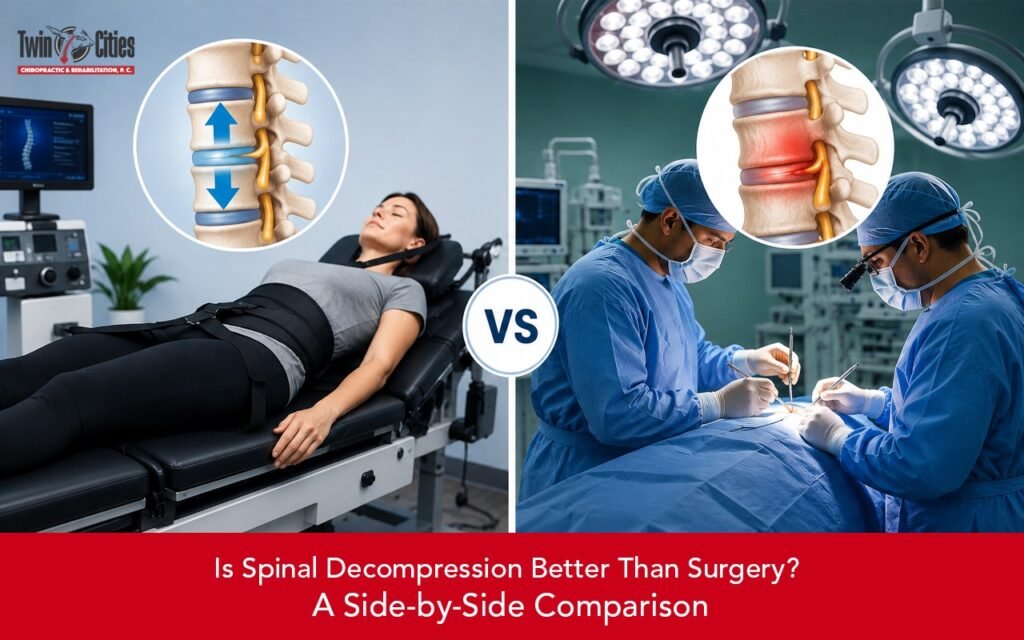
You’re standing at a major fork in the road. On one side, your doctor is talking about a surgical consultation—discectomies, fusions, and hospital stays. On the other side, you’ve heard about a non-invasive option called spinal decompression that claims to fix the same problem without a single incision.
If you’re currently weighing these two options, you’re likely feeling a mix of desperation for relief and a healthy dose of fear. You want the pain to stop, but you don’t want to make a permanent mistake with your spine.
Before we dive into the “Machine vs. Knife” comparison, it’s important to know exactly what you’re dealing with. If you’re still not 100% sure if your symptoms match a true herniation, I recommend starting with our complete guide to herniated disc symptoms and causes.
But if you already have the MRI results in hand and you’re trying to decide how to proceed, this guide is for you. At Twin Cities Chiropractic, Dr. Scot Sorum has spent 25 years helping St. Paul residents navigate this exact decision. Let’s look at the hard facts regarding costs, recovery times, and success rates for non-surgical treatment for herniated discs vs. traditional back surgery.
The Surgical Path: What They Don’t Always Tell You
Surgery is often presented as the “permanent” fix. The logic seems sound: if a piece of disc is pressing on a nerve, just cut it out, right? While surgery is absolutely necessary in emergency cases—like when you lose control of your bladder or your leg goes numb and weak—for the average herniated disc patient, the “quick fix” of surgery comes with long-term strings attached.
1. The “Failed Back Surgery” Risk
There is a real medical term called Failed Back Surgery Syndrome (FBSS). It refers to the 20% to 40% of patients who undergo back surgery and either find no relief or end up in more pain than before the operation. When you cut into the delicate structures of the spine, you create scar tissue. That scar tissue can eventually wrap around the very nerves the surgeon was trying to save, leading to chronic, “tethered” nerve pain that is incredibly difficult to treat.
2. The Domino Effect (Adjacent Segment Disease)
This is the biggest risk with spinal fusions. When a surgeon bolts two of your vertebrae together, that section of your spine can no longer move. But your body still needs to bend and twist. To make up for the “stuck” segment, the discs directly above and below the fusion have to work twice as hard. Think of it like a chain—if you weld two links together, the links on either side take all the stress. Within 5 to 10 years, it is very common for those adjacent discs to wear out and herniate, leading to a second, even more invasive surgery.
The Decompression Path: How the “Vacuum” Works
Spinal decompression is the primary non-surgical treatment for herniated disc issues because it works with your body’s natural healing process rather than overriding it.
Instead of cutting away disc material, we use a computerized table to create negative pressure (a vacuum) inside the disc. This vacuum does two things that surgery cannot:
- Retraction: It gently coaxes the bulging “jelly” back toward the center of the disc, away from the nerve.
- Rehydration: It pulls fresh blood, oxygen, and nutrients into the disc. Discs are like sponges; they need this “pumping” action to stay healthy. Surgery removes tissue; decompression restores it.
The Financial Reality: Comparing the Costs
When comparing spinal decompression vs surgery, we have to talk about the numbers. In the United States, the average cost of a single-level spinal fusion can range from 30,000 to over 80,000, depending on the hospital and complications. Even with “good” insurance, your out-of-pocket deductibles and co-pays can easily reach 5,000 to 10,000.
But the “hidden” costs of surgery are what really hurt St. Paul families:
- Lost Wages: Most back surgeries require 6 to 12 weeks of restricted activity. If your job involves any physical labor or long commutes, that is three months of zero income.
- Physical Therapy Costs: Post-surgical rehab is mandatory and often requires 20+ visits to a separate facility, adding more co-pays to your bill.
In contrast, a full 6-week course of spinal decompression costs a fraction of that. Most importantly, there is zero lost income. You can come into our Lexington Parkway office for your 20-minute session and go straight back to work or to your family at home.
Recovery Timeline: Life After Treatment
This is where the two paths diverge the most. Let’s look at what your life looks like the day after each treatment.
The Day After Surgery:
You are likely in a hospital bed or heavily medicated at home. You have a surgical wound that needs care, and you are under strict “no lifting, no twisting, no bending” orders. You need help getting to the bathroom, and you aren’t allowed to drive for several weeks.
The Day After Your First Decompression Session:
You wake up at home. You might feel a little “loose” or slightly sore (like you had a good workout), but you are fully mobile. You can drive yourself to work, go grocery shopping, and pick up your kids. There are no incisions to heal and no risk of infection.
Success Rates: What the Data Says
When patients ask about the spinal decompression success rate, they are often surprised to find it is comparable to—and sometimes better than—surgery for long-term outcomes.
Clinical research consistently shows that 71% to 89% of patients with herniated discs experience significant pain relief and a return to their normal activities after completing a full decompression protocol.
The key difference is the “Downside Risk.” If decompression doesn’t work for you (which happens in about 15% of cases), you haven’t lost anything. Your spine is still intact, and you can still choose surgery later. But if surgery doesn’t work, you can’t “undo” the cutting or the hardware. You have permanently altered your anatomy.
Why We Combine Decompression with Massage and Adjustments
To achieve those high success rates in our St. Paul office, we don’t just rely on the machine. We know that if you’ve been in pain for months, your entire body has “compensated.” You’re likely walking with a limp, your pelvis is tilted, and your muscles are in a permanent state of “guarding.”
This is why our integrated treatment approach is so vital:
- Sorum’s Adjustments: We ensure the vertebrae around the herniated disc are moving correctly. If the joints are stuck, the decompression can’t do its job effectively.
- Joy Vang’s Massage: Joy works specifically on the “protective” muscle spasms in your lower back and glutes. By releasing these tight muscles, we allow the spine to stay in its new, healthy alignment.
Making the Choice: Is It Time to Cancel the Surgery?
If you don’t have “Red Flag” symptoms (like loss of bowel/bladder control or progressive paralysis), you owe it to yourself to try the non-surgical path first.
Surgery will always be there as a last resort. But once you go under the knife, there is no going back. Spinal decompression offers a high-tech, high-success alternative that preserves your spine and gets you back to your life in St. Paul without the months of recovery.
Are you ready to see if you can avoid the operating room? Call TwinCitiesChiropractic at 651-224-1921. We are located at 506 N. Lexington Parkway in St. Paul. Dr. Sorum has 25 years of experience helping patients find lasting relief through non-surgical spinal decompression. Call today to schedule your consultation and take the first step toward a pain-free life.
FAQs
1. How do I know if I’m actually a candidate for spinal decompression?
The best way to know for sure is to let us look at your MRI. Generally, if you have a confirmed herniated or bulging disc and you’re experiencing “radicular” symptoms—that’s the fancy word for pain, numbness, or tingling that travels down your arm or leg—you’re likely a great candidate. We look for people who haven’t found relief with standard physical therapy or injections but aren’t ready to commit to the risks of surgery.
2. Can I still try decompression if I’ve already had a back surgery that failed?
We see this all the time in our St. Paul office. It’s called “Failed Back Surgery Syndrome,” and it’s heartbreaking. In many cases, yes, you can still do decompression. As long as you don’t have metal hardware (like rods, cages, or screws) in the exact area we are treating, the computerized table can still help create that vacuum effect to relieve pressure on the nerves that the surgery didn’t fix. We’ll do a very thorough screening first to make sure it’s safe for your specific situation.
3. How soon will I start to feel a difference?
I wish I could tell you that you’ll feel 100% better after one session, but that’s just not how biology works. We’re trying to rehydrate a disc that has been compressed for months or even years. Most of our patients start to feel a “shift” in their pain levels somewhere between the 6th and 10th session. Usually, the first thing people notice isn’t that the pain is gone, but that it’s “centralizing”—meaning it’s moving out of the leg and back into the lower back. That is a huge sign of progress.
4. Is the spinal decompression success rate really that high?
Yes, the data is very consistent. When you look at clinical studies, the success rate for non surgical treatment for herniated disc issues using decompression is between 71% and 89%. Compare that to the long-term success rate of spinal fusions, which can be as low as 50% after five years, and the choice becomes much clearer. The reason our success rate is so high is that we don’t just use the machine; we combine it with adjustments and massage to fix the whole system.
5. Does insurance cover this treatment in Minnesota?
This is a very common question. Many major insurance providers in Minnesota do cover spinal decompression when it’s part of a medically necessary chiropractic treatment plan. Every policy is a little different, which is why we offer a free benefits check. We’ll call your provider for you and find out exactly what your co-pay or deductible looks like before you ever start treatment. We hate financial surprises as much as you do.
6. What happens if I stop the treatment program early?
Think of spinal decompression like a course of antibiotics or wearing braces. If you stop halfway through because the pain is “mostly gone,” you haven’t actually finished the healing process. The vacuum effect needs consistent, repetitive sessions to fully “suck” that disc material back in and allow the outer layer of the disc to scar over and strengthen. If you quit early, the disc is still vulnerable, and there’s a high chance the herniation will just pop right back out the next time you sneeze or bend over.
7. Is there any risk of making the herniation worse?
Because our table is computerized and uses biofeedback, the risk is incredibly low. Unlike old-school traction that could sometimes cause a muscle to “snap” and pull on a disc, our table senses your muscle tension. If your body resists, the machine stops pulling. It is much, much safer than the forceful movements involved in high-impact sports or even heavy lifting at home.