
How Much Does Spinal Decompression Therapy Cost in St. Paul?
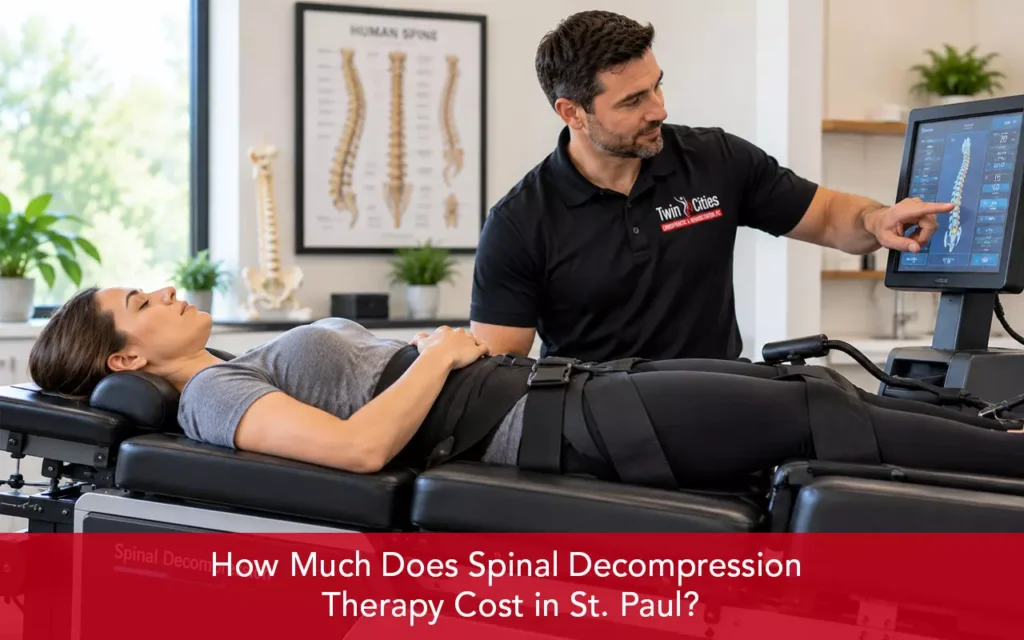
Price comes up in almost every decompression consultation I do, usually right after “will it hurt?” and sometimes before it. That makes sense. Someone with a herniated disc has often already paid for months of pills, a round of physical therapy, maybe an injection or two, and now they’re wondering whether this is one more bill that won’t fix anything. So let me lay out what spinal decompression therapy costs, why the prices you find online are all over the map, how insurance usually handles it here in Minnesota, and what to look out for while you shop around.
Spinal Decompression Therapy Cost: The Plain Numbers
Look up the cost of spinal decompression treatment online, and you’ll find single sessions priced as low as $60 and as high as $200. The clinics that actually post their prices mostly charge between $75 and $150. Per visit, that doesn’t sound too bad.
Nobody comes in for just one session, though, and that’s where the real cost is. Decompression takes pressure off the disc a little at a time. So we usually see people three or four times a week at the start, then space visits out once the leg pain starts backing off. For most of my patients, that adds up to somewhere between 15 and 30 visits over four to eight weeks. Say a clinic charges $100 a visit and you need 20 of them. That’s $2,000 before insurance pays anything. Across clinics in general, a full course paid in cash usually lands between about $1,000 and $6,000. Where you fall mostly comes down to how many visits your disc needs and what’s included in each one.
I know a range that wide isn’t very satisfying. So let me walk through what pushes the number up or down.
Why One Clinic Charges $60 and Another Charges $200
When patients bring me a lower quote from somewhere else, I always tell them to find out what that price actually buys. Most of the time the difference comes down to three things.
How many sessions your condition needs
Of everything on this list, the number of visits moves the total the most. If your back started bugging you three weeks ago after you hauled a pile of mulch bags around the yard, you’ll probably need a lot less from me than somebody who’s been living with numbness down into the foot for a couple of years. A small bulge we catch early might settle down in 12 to 15 visits. When there’s stenosis in the picture, or more than one disc involved, or the symptoms have just been around forever, it can take 30 or more, and that by itself can roughly double what you pay. People do call and ask me for a total over the phone, and I get why, but I’d only be guessing until I’ve examined you and looked at your MRI.
What happens during each visit
It’s worth asking any clinic what the price actually includes. In some offices you’re paying for about 20 minutes on the table and nothing else. Other places roll adjustments, soft tissue work, heat or ice, and some exercise coaching into the same visit. In our office, decompression pretty much never happens on its own. The table does a good job of taking pressure off the disc. But if the muscles in your low back are still locked up and your hips hardly move, you go right back to loading that disc the old way the minute you’re up and walking out to the parking lot. That’s why most of our decompression patients also spend time with Joy Vang for massage and leave with a handful of exercises to do at home. So when you see a really low per-session price somewhere, it may just mean less is happening while you’re there.
The equipment itself
True spinal decompression uses a computer-controlled table that pulls in a slow cycle, easing the tension on and off so your back muscles don’t fight it. A basic traction table, or an inversion setup, isn’t the same treatment, even when it’s marketed under the same name. Computerized tables cost a clinic a lot more to buy and maintain, and that shows up in the price. If you’re comparing quotes, ask what kind of table they use.
Does Insurance Cover Spinal Decompression in Minnesota?
Sometimes. Coverage depends on your plan, the reason you’re being treated, and how the care gets billed, so it really does vary from one person to the next. Here’s what we usually see with the different kinds of coverage our St. Paul patients have.
Private health insurance. Many plans won’t pay for the decompression table as its own line item, but they will cover the exam and parts of a chiropractic treatment plan when the care is medically necessary. What’s left over may be yours to pay. Our staff will run a free benefits check before you start, so you know what your plan pays and what it doesn’t before you commit to anything.
Medicare. Medicare doesn’t cover decompression as a standalone service. It covers specific chiropractic adjustments, so if you’re on Medicare, expect the decompression portion to be out of pocket.
Auto accidents. This is where things often look a lot better. Minnesota is a no-fault state, which means your own auto policy’s Personal Injury Protection usually pays your medical bills after a crash, regardless of who caused it. If a car accident caused or aggravated your disc injury, decompression may be covered as part of your accident care, and we bill the auto insurer directly.
Work injuries. Workers’ compensation generally covers necessary treatment for a disc injury that happened on the job, as long as the claim is accepted.
HSA and FSA accounts. Many patients use health savings or flexible spending dollars for decompression. Check with your plan administrator to be sure, but this is often a good way to pay with pre-tax money.
If your plan comes back with little or no coverage, ask about payment plans. Spreading the cost over the length of your treatment helps a lot of families make it work. You can see how we handle billing for other visits in our post on chiropractic costs and pricing in St. Paul.
Is It Worth the Money Compared to Surgery?
For the right patient, I think so, but I want to be careful with that answer. Decompression costs a fraction of what back surgery does, even after insurance. Between deductibles, co-pays, time off work, and the weeks of rehab afterward, surgery is a much bigger financial hit for most families. I’ve written a full side-by-side of the two in our post on spinal decompression vs. surgery, including recovery time and what the success rates look like.
Being cheaper doesn’t make decompression the right choice for everybody, though. If your leg is getting weaker week by week, or you’re having trouble controlling your bladder or bowels, you need a surgeon, and you need one soon. The same goes when an MRI shows a piece of disc pressing hard on a nerve. On the other end, plenty of people who ask me about decompression don’t need it at all. Their back gets better with adjustments, some massage, and a few exercises, and that costs a lot less. When that’s the case, I tell them so, even though it means they spend less money with us.
Red Flags When You’re Shopping Around
Most chiropractors who offer decompression are fair about pricing. A few aren’t, and I hear about it from patients who come to us after a bad experience elsewhere. Be cautious if you run into any of these:
- Pressure to sign up and prepay for a large package on the very first visit, before an exam or a look at your imaging
- A “today only” discount that disappears if you go home and think about it
- Promises that decompression will fix your back for good, or a guaranteed success rate
- A recommendation for 40 or more sessions with no plan to recheck how you’re responding
- Vague answers when you ask what’s included in the price
A reasonable plan has check-in points built into it. We reassess around the 10th to 12th session, and if you’re not improving by then, we talk about it openly and change course instead of just adding more visits.
What It Costs at Twin Cities Chiropractic
Our pricing works on time, not on which treatment you get. That’s how we charge for everything here, and decompression is no different. Thirty minutes is $45, 45 minutes is $55, and an hour is $70. The decompression itself takes 20 to 30 minutes on the table, so if that’s all you’re coming in for, you’re in the $45 slot. Most of my decompression patients book 45 minutes or an hour, though. That gives us time to fit in an adjustment, or some work with Joy on tight muscles, without a second appointment. We do have longer slots, $135 for 90 minutes and $159 for two hours, but decompression patients rarely need them.
To put that in perspective, a 20-visit course of 30-minute sessions comes to $900 before any insurance, well under what most clinics charge. If you want to save a little more, we offer a prepaid package of four 60-minute sessions for $260. That works out to $65 an hour and saves you $20 over paying visit by visit.
Your first visit includes a consultation and exam, a review of any MRI you already have, and a frank talk about whether decompression is a good fit for your back, so it may cost a bit more than a regular follow-up. New patients pay when they book to hold that first time slot. If decompression is right for you, you’ll leave with a written plan showing how many sessions I expect you’ll need and what the total comes to, before you start. If it isn’t, I’ll tell you that too, along with what I’d do instead.
You can read more about how the treatment works, who it helps, and who shouldn’t have it on our spinal decompression therapy page.
Find Out What Your Treatment Would Cost
If disc pain or sciatica has been wearing you down and you want a straight answer on cost, call Twin Cities Chiropractic at (651) 224-1921 or stop by 506 N. Lexington Pkwy, St. Paul, MN 55104. Bring your insurance card and any imaging you have, and we’ll go over the numbers together.
Frequently Asked Questions
- How much does spinal decompression cost per session?
Around the country, cash prices run anywhere from $60 to $200 a session, and $75 to $150 is typical. Here, a 30-minute session is $45. Before you compare prices, find out whether you’re paying for table time only or for other treatment too.
- How much does a full course of spinal decompression cost?
That depends mostly on how many visits you need, and for most people it’s somewhere between 15 and 30. At the prices most clinics charge, a full course paid in cash usually runs about $1,000 to $6,000. With our rates, it’s quite a bit less. Twenty half-hour visits here come to $900. If insurance or no-fault picks up part of it, or you use the prepaid package, your share goes down from there.
- Does insurance pay for spinal decompression?
Sometimes. A lot of health plans will pay for the exam and the chiropractic care but not for time on the decompression table. Medicare won’t cover decompression on its own. After a car accident or a work injury, though, Minnesota no-fault or workers’ comp often picks it up. We’ll check your benefits for free before your first session and tell you what’s left for you to pay.
- Can I use my HSA or FSA for spinal decompression?
Often, yes, when it’s treatment for a diagnosed condition like a herniated disc. Check with your plan administrator to confirm.
- Is spinal decompression painful?
No. Most people find it relaxing, and some fall asleep on the table. We go through what a session feels like in our post on whether spinal decompression is painful.