
Whiplash and Concussion Symptoms After a Crash: How to Tell Them Apart
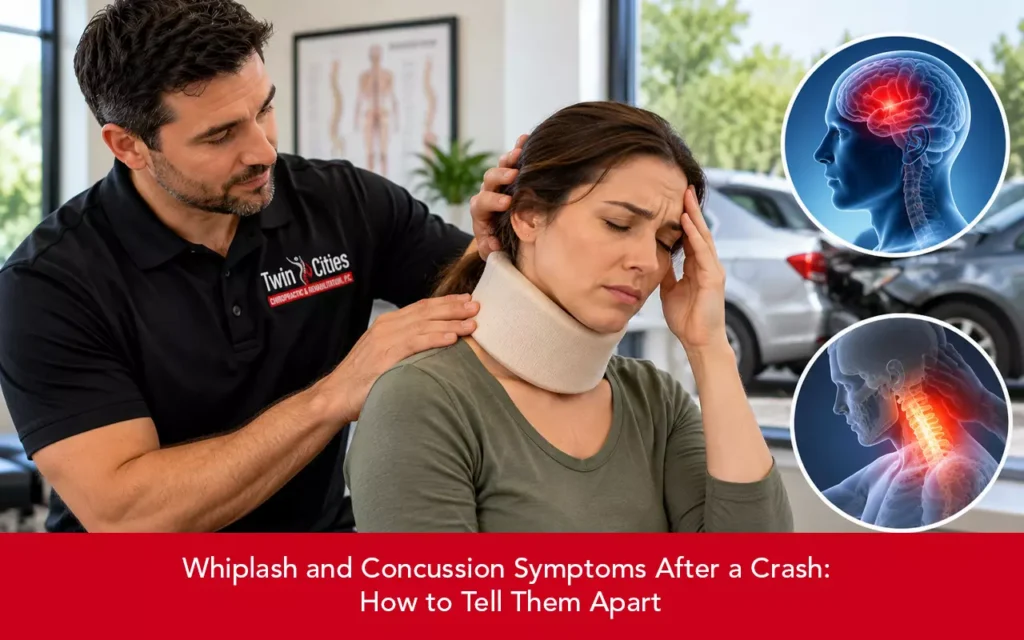
After a car accident, most people worry about their neck. Fewer think about their brain, especially if they never hit their head. That’s a gap I see all the time in our St. Paul office. Someone comes in a week after a rear-end collision on I-94 with a headache, some dizziness, and trouble focusing at work, and they assume it’s all whiplash. Sometimes it is. Sometimes there’s a concussion sitting underneath it that nobody has checked for.
The two injuries happen in the same split second and share a lot of the same symptoms, which is exactly why they get mixed up. Here’s how I explain the difference between concussion and whiplash to patients, which symptoms point one way or the other, and when you need to be seen right away.
Why a Crash Can Cause Both at Once
Whiplash is an injury to the soft tissues of the neck: the muscles, ligaments, and small joints that get stretched when your head snaps back and forth. A concussion is a mild traumatic brain injury. It happens when the brain shifts and twists inside the skull hard enough to disrupt how brain cells work for a while.
What surprises a lot of people is that you don’t have to hit your head to get a concussion. The same rapid acceleration and deceleration that strains your neck can also jolt your brain. A low-speed fender bender in a Cub Foods parking lot can do it. So can sliding into the car ahead of you on a glazed-over Snelling Avenue in January. The airbag may not even deploy.
Because both injuries come from the same motion, it’s common to have some of each. And because the neck and brain are wired so closely together, a hurt neck can produce symptoms that feel “brain-related,” and a concussion can make neck pain feel worse. That overlap is the whole reason this topic deserves more than a quick once-over.
Whiplash and Concussion Symptoms That Overlap
Headache is the big one. Both whiplash and concussion can cause headaches, and they often start a day or two after the crash rather than right away. Dizziness, fatigue, poor sleep, irritability, and trouble concentrating can show up with either one too. If you’ve had a rough week of all of the above, it’s very hard to sort out on your own what’s coming from where.
The delay matters as well. Whiplash symptoms commonly build over 24 to 72 hours as inflammation sets in, which we explain in detail in our post on why whiplash symptoms appear days after an accident. Concussion symptoms can also creep in over the first day or two. So “I felt fine at the scene” doesn’t rule out either one.
Clues That Point More Toward Whiplash
Neck pain from whiplash behaves like a mechanical problem. Turn your head to back out of the driveway, and it catches. Look down at your phone for ten minutes, and it aches. Most people can put a finger right on the sore spots, usually along the side of the neck, across the tops of the shoulders, or down between the shoulder blades.
The headaches have a pattern too. They tend to start at the base of the skull, often on one side, and creep up over the head toward the eye. We call these cervicogenic headaches, which is just a fancy way of saying they come from the neck. If a headache gets better or worse depending on how you hold your head, that’s a strong hint. Some patients also feel a little unsteady when they turn quickly. That kind of dizziness usually comes from the upper neck, where sore joints and tight muscles throw off your sense of where your head is.
Clues That Point More Toward Concussion
Concussion symptoms tend to be about how the brain is processing things rather than how the neck moves. People describe feeling foggy, slowed down, or “not quite right.” They lose their train of thought mid-sentence, reread the same email three times, or can’t follow a conversation in a noisy room.
Other common concussion signs include:
- Sensitivity to light or noise
- Nausea, especially early on
- Blurry or double vision, or eyes that tire quickly when reading or using screens
- Memory gaps around the crash
- Feeling unusually emotional, anxious, or irritable
- Sleeping much more or much less than normal
A headache that feels like pressure inside the whole head, rather than tightness starting at the neck, also leans more toward concussion. None of these signs is proof on its own, but if several of them are on your list, a concussion needs to be ruled out by a medical provider.
When to Go to the Emergency Room
Some symptoms after a crash can’t wait for an appointment. Go to the ER or call 911 if you or someone with you has:
- A headache that keeps getting worse
- Repeated vomiting
- Confusion, slurred speech, or trouble recognizing people or places
- One pupil larger than the other
- Seizures, or being very hard to wake up
- New weakness, numbness, or tingling in the arms or legs
- Loss of consciousness, even briefly
One more: if your neck hurts badly right after the crash, or your arms or hands go numb, get imaging first. Nobody should be adjusting that neck until a scan says it’s safe. I’d rather meet you a week later with a clean CT in hand.
Why It Matters to Get the Right Answer
Getting this wrong cuts both ways. Call a concussion “just whiplash,” and people go right back to full workdays in front of a screen, skip the rest their brain actually needs, and then can’t understand why the headaches keep coming back. Flip it around and blame everything on the concussion, and the neck gets ignored. Then the headaches and dizziness that would have eased with neck treatment hang on far longer than they should.
This is where working together with other providers pays off. In our office, if I suspect a concussion, I refer you to a medical provider for that evaluation. Chiropractic care doesn’t treat the brain injury itself. What we can do is treat the neck side of the problem, which is often a big part of why post-accident headaches drag on for weeks. Our approach to headache treatment in St. Paul looks closely at the neck for exactly that reason.
How We Help After a Crash
The first visit starts with a careful history of the accident and a screening for concussion warning signs before we touch your neck. If anything raises concern, we stop there and get you to the right provider first.
When it’s appropriate to treat, we focus on what’s going on in your neck and upper back. That usually means gentle adjustments to restore motion in stiff joints, soft tissue work and massage with Joy Vang to calm muscles that have been guarding since the crash, and specific exercises to retrain neck control and balance. For patients who are also recovering from a concussion, we keep treatment gentle and adjust the pace based on how they’re feeling that day and what their medical provider recommends.
We also help with the practical side. In Minnesota, no-fault auto insurance generally covers medical care after a crash regardless of who caused it, and we work with those claims regularly so you can focus on getting better.
Get Checked After Your Accident
If you’ve been in a crash and you’re dealing with headaches, dizziness, or neck pain that hasn’t settled, don’t wait it out. Call Twin Cities Chiropractic at (651) 224-1921 or stop by 506 N. Lexington Pkwy, St. Paul, MN 55104.
Frequently Asked Questions
- Can you get a concussion without hitting your head?
Yes. The rapid back-and-forth motion of a crash can shake the brain inside the skull even if your head never touched anything. That’s why concussion screening matters after any significant collision. - How do I know if my headache is from whiplash or a concussion?
Neck-related headaches usually start at the base of the skull and change with neck movement. Concussion headaches often feel like pressure throughout the head and come with fogginess, light sensitivity, or nausea. Many people have some of both, so an exam is the best way to sort it out. - How long do whiplash and concussion symptoms last?
Most people with a mild concussion improve within a few weeks, though some take longer. Whiplash recovery varies widely depending on the severity and how early it’s treated. Our post on how long whiplash lasts goes through the typical timeline. - Should I see a chiropractor if I think I have a concussion?
See a medical provider first to evaluate the concussion. A chiropractor can then help with the neck injury that often comes with it, working alongside your doctor’s recommendations. - Does Minnesota no-fault insurance cover chiropractic care after a car accident?
In most cases, yes. Minnesota’s no-fault coverage generally pays for medical treatment, including chiropractic care, after an auto accident regardless of fault. Call us, and we’ll help you check your coverage.