
Plantar Fasciitis: How Chiropractic Care Fixes Stubborn Heel and Foot Pain
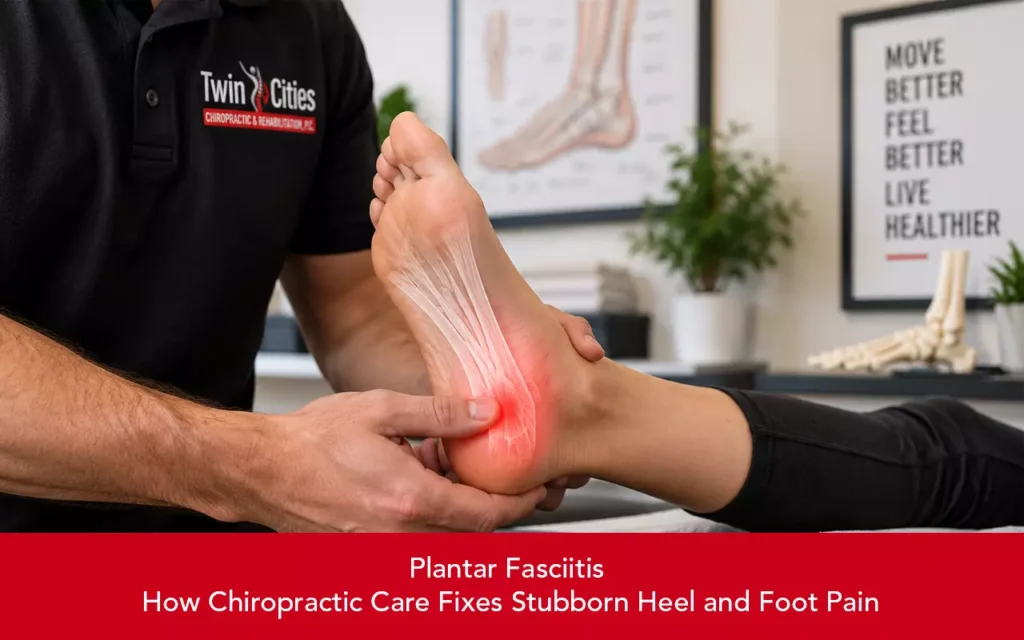
If the first few steps out of bed feel like you’re walking on a bruise, and the pain eases after you move around for a few minutes, there’s a good chance you’re dealing with plantar fasciitis. It’s one of the most common reasons active people limp into our office, and it’s also one of the most misunderstood. Most patients I see have already tried the frozen water bottle, the new insoles, and a couple of weeks off running. Some of that helps for a while. Then the pain comes back, usually right when they start training again.
Here’s what I tell patients in the exam room: the heel is where it hurts, but it’s rarely where the problem starts. That’s why a plantar fasciitis chiropractor looks at far more than your foot.
The “Bowstring” Under Your Foot
The plantar fascia is a thick band of tissue that runs from the bottom of your heel bone out to the base of your toes. Think of it as a bowstring holding up the arch. Every time your foot hits the ground, that band stretches a little and absorbs load. When you push off, it tightens and helps turn your foot into a stiff lever so you can move forward.
It’s built to handle a lot, but not unlimited amounts. When the load goes up faster than the tissue can adapt, small areas of irritation and breakdown develop where the fascia attaches to the heel. In longer-standing cases, the tissue isn’t really “inflamed” anymore so much as worn and poorly healed. That’s one reason anti-inflammatory pills and rest alone often don’t finish the job.
The morning pain has a simple explanation. Overnight, your foot relaxes in a pointed position, and the fascia tightens up. Your first steps stretch it suddenly, and it lets you know. The same thing happens after sitting through a long meeting or a drive home on I-94.
It’s Rarely “Just a Foot Problem”
Before I touch a sore heel, I have you walk across the room a few times with your shoes off. Then I’ll ask you to squat, stand on one leg, and lean your knee toward the wall to see how far your ankle bends. More often than not, the foot turns out to be only part of the story. A stiff ankle or a hip that lets the knee drift inward adds pull on that bowstring with every step. These are the patterns that come up again and again:
•Tight calves and a stiff ankle. If your ankle can’t bend forward well, the foot flattens and twists to make up the difference, and the fascia takes the strain.
• Weak hips. When the muscles on the side of your hip don’t control your knee, the leg rolls inward, and the arch collapses with every step.
• Sudden jump in training. Adding miles, hills, or speed work too quickly is the classic trigger for runners.
• Hours standing on hard floors. Nurses, teachers, retail workers, and anyone who spends a shift on concrete shows up in our office with this regularly.
• Worn-out or unsupportive shoes. That favorite pair with 500 miles on it isn’t doing you any favors.
St. Paul has a very specific seasonal rhythm to this. Every fall we see runners building mileage for the Twin Cities Marathon along Summit Avenue and Mississippi River Boulevard. Then after a long winter indoors, people who walked Como Lake once a week in January suddenly go back to daily runs in April. Adult softball and pickleball leagues start up at the same time. The foot hasn’t changed, but the demand on it has, and the fascia can’t keep up.
What Most People Try First (and Why It Stalls)
Most of my patients aren’t doing anything wrong. They’re just doing the part of the fix that addresses the symptom. Rolling the foot on a ball, icing, stretching the arch, and buying a better shoe can all calm the heel down. The trouble is that none of those things change the stiff ankle, the tight calf, or the hip that lets the knee cave in.
So the pattern goes like this. You rest for two weeks, the pain drops, you go back to your normal routine, and within a month you’re limping again. Others push through it for months, and the tissue gets more irritated and harder to settle.
How We Treat Plantar Fasciitis at Twin Cities Chiropractic
Our approach follows the same process we use for all sports injury treatment in St. Paul: find why the tissue is overloaded, calm it down, then rebuild so it doesn’t come back. For plantar fasciitis, that usually looks like this:
1. Full lower-body evaluation. I’ll check your ankle range of motion, calf flexibility, hip strength, and how your foot moves when you walk and run. We use video and biomechanical analysis so you can see what’s happening too.
2. Mobilization and adjustments. Restoring motion in a stiff ankle and in the small joints of the foot takes pressure off the fascia. We also check the knee, hip, and low back, since restrictions higher up change how you load the foot.
3. Soft-tissue work. Myofascial release and trigger point therapy on the calf and the bottom of the foot help loosen tissue that’s been guarding for weeks. Many patients also book therapeutic massage with Joy Vang to keep the calves and lower legs moving well during recovery.
4. Therapeutic modalities. Depending on your case, we may use cold laser therapy, electrical stimulation, or ultrasound to help settle pain and support tissue healing.
5. Targeted strengthening. Your foot, calf, and hip muscles need to get stronger to handle load again.
5. Targeted strengthening. Your foot, calf, and hip muscles need to get stronger to handle load again.
6. A real return-to-running plan. Instead of “take a few weeks off,” you get a step-by-step plan back to your normal mileage or sport.
Dr. Scot Sorum has spent 25 years treating athletes and active adults, and a big part of that is understanding that people want to keep moving while they heal. We’ll adjust your training, not take it away, whenever that’s safe. If you want a broader look at our philosophy with athletes, our post on how a sports injury chiropractor gets athletes back in the game covers it.
What Recovery Actually Looks Like
Timelines are usually the first thing people ask about, so here’s the straight answer. For a lot of patients, mornings start to loosen up within the first month of regular visits and homework. If you’ve put up with this since last summer, you shouldn’t expect the same pace, and I’d rather tell you that on day one than have you frustrated by week five.
Where you really win or lose this is at home. I’ll send you out with a short routine, usually slow calf raises off the bottom stair, a towel looped around the ball of your foot for a stretch before you even sit up in bed, and some one-leg balance work that fits into the two minutes you spend brushing your teeth. It adds up to about ten minutes a day, and the patients who stick with it get better faster. Then we adjust the things around it, like putting an anti-fatigue mat under a standing desk or breaking a Saturday long run into a morning and an evening run for a few weeks.
Getting back to running happens in steps. First you walk without pain. Then come short, easy jogs on flat ground. Hills, speed work, and your long run come back last. Rush that order, and your heel will usually tell you within a day or two.
Get Your Heel Checked Before It Becomes a Season-Long Problem
Heel pain that lasts more than two or three weeks deserves a proper look. Call Twin Cities Chiropractic at (651) 224-1921 or stop by our office at 506 N. Lexington Pkwy, St. Paul, MN 55104. We’ll figure out what’s driving your pain and build a plan that keeps you moving.
Frequently Asked Questions
1. Can a chiropractor really help plantar fasciitis?
Yes. The heel is just where the trouble shows up. Most of what we do is aimed higher up the chain: getting a stiff ankle to bend again, working the knots out of your calf, and building strength in the hips and small foot muscles so the fascia stops getting yanked on with every stride.
Yes. The heel is just where the trouble shows up. Most of what we do is aimed higher up the chain: getting a stiff ankle to bend again, working the knots out of your calf, and building strength in the hips and small foot muscles so the fascia stops getting yanked on with every stride.
2. How long does plantar fasciitis take to heal?
Mostly, it depends on how long you’ve had it. Caught early, a lot of people feel better within a few weeks. If it’s been bothering you for six months or more, expect a few months of steady work.
Mostly, it depends on how long you’ve had it. Caught early, a lot of people feel better within a few weeks. If it’s been bothering you for six months or more, expect a few months of steady work.
3. Should I keep running with plantar fasciitis?
Maybe. If it grumbles for the first mile and then quiets down, you can usually keep running for now; just cut the distance and swap the sidewalk for a trail or a school track. If you’re limping afterward, or it hurts more the longer you go, stop running and come see us.
Maybe. If it grumbles for the first mile and then quiets down, you can usually keep running for now; just cut the distance and swap the sidewalk for a trail or a school track. If you’re limping afterward, or it hurts more the longer you go, stop running and come see us.
4. Is my heel spur causing the pain?
Probably not. Plenty of people have a spur on their X-ray and never feel a thing. The fascia is usually what hurts, and we treat it the same way either way.
Probably not. Plenty of people have a spur on their X-ray and never feel a thing. The fascia is usually what hurts, and we treat it the same way either way.
5. When is heel pain something more serious?
Call your doctor or us sooner rather than later if you notice numbness or tingling, a pop followed by swelling or bruising, pain that wakes you up at night, or pain when you squeeze both sides of your heel. Those point toward a nerve issue, a tear, or a stress fracture. If you need imaging, we’ll tell you and send you to the right place.
Call your doctor or us sooner rather than later if you notice numbness or tingling, a pop followed by swelling or bruising, pain that wakes you up at night, or pain when you squeeze both sides of your heel. Those point toward a nerve issue, a tear, or a stress fracture. If you need imaging, we’ll tell you and send you to the right place.