
Massage Therapy vs. Chiropractic: Why You Need Both for Recovery
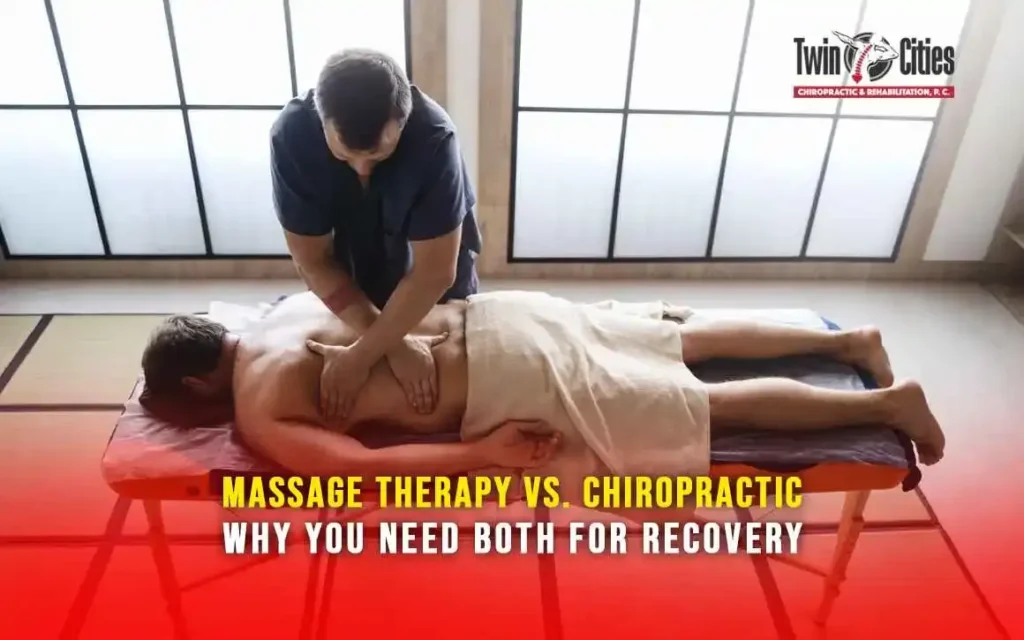
Should you see a massage therapist or a chiropractor for your back pain?
Wrong question. You need both.
Most people think they have to choose—either book a massage or see a chiropractor. But your body doesn’t work in separate compartments. Your bones, joints, muscles, and soft tissue are all connected. Treating only one part means you’re missing half the problem.
At Twin Cities Chiropractic in St. Paul, we don’t make you choose. Dr. Scot Sorum handles the structural side—your spine, joints, and alignment. Joy Vang, our licensed massage therapist, handles the soft tissue side—your muscles, fascia, and trigger points. Together, they address the whole problem, not just part of it.
Let me explain why trying to fix your pain with only massage or only chiropractic is like trying to fix a car with only half the tools.
What’s the Difference Between Massage Therapy and Chiropractic?
Let’s start with the basics, because a lot of people don’t really understand what each one does.
Chiropractic care focuses on your skeletal system—your spine, joints, and how they’re aligned. When vertebrae get misaligned (we call these subluxations), they can pinch nerves, restrict movement, and cause pain. Dr. Sorum uses specific adjustments to realign your spine, restore proper joint function, and take pressure off nerves.
Think of chiropractic as addressing the framework of your body. If your spine is out of alignment, everything else suffers.
Massage therapy focuses on your soft tissues—muscles, tendons, ligaments, and fascia (the connective tissue that wraps around everything). When you’re injured or in pain, your muscles tighten up, develop trigger points (those painful knots), and form scar tissue. Joy uses hands-on techniques to release tension, break up adhesions, improve circulation, and help damaged tissue heal.
Think of massage as addressing the support system around your framework. If your muscles are tight and full of knots, they’ll pull your bones out of alignment.
See the problem? You can’t fix one without addressing the other.
Why Your Bones and Muscles Are a Package Deal
Here’s what happens when you only treat half the problem:
Scenario 1: You only get chiropractic adjustments
Dr. Sorum adjusts your spine, gets everything aligned perfectly, and you feel great for a day or two. Then the pain comes back. Why? Because your muscles are still tight and pulling your vertebrae back out of alignment. It’s like straightening a picture frame while someone’s tugging on one corner—it’s just going to tilt again.
Scenario 2: You only get massage therapy
Joy works out all the muscle tension, releases the trigger points, and you walk out feeling loose and relaxed. A few days later, the muscles are tight again. Why? Because your spine is still misaligned, and those misaligned vertebrae are causing your muscles to spasm and tighten up to protect the area.
The solution: Both
Dr. Sorum adjusts your spine to fix the structural problem. Joy releases the muscle tension so those adjustments hold. Your muscles can finally relax because the bones are in the right place. Your bones stay in the right place because the muscles aren’t pulling them out of alignment. Everything works together the way it’s supposed to.
This is how bodies actually heal—not by addressing symptoms in isolation, but by treating the whole interconnected system.
How Massage Therapy Enhances Chiropractic Care
Let’s talk about what happens when you combine massage with chiropractic adjustments.
Relaxed Muscles Make Adjustments More Effective
When your muscles are tight and guarding, it’s harder to adjust your spine. The adjustment still works, but it takes more force, and it might not move as far as it needs to.
When Joy works on your muscles first—releasing tension, breaking up adhesions, getting blood flow into the area—your muscles are relaxed and pliable. Now when Dr. Sorum adjusts you, your spine moves more easily into the correct position. The adjustment is gentler, more precise, and more effective.
Massage Reduces Post-Adjustment Soreness
Some people feel a little sore after their first few chiropractic adjustments, especially if their spine has been misaligned for a while. That soreness comes from muscles that have been compensating for the misalignment suddenly having to work differently.
Massage therapy after an adjustment helps reduce that soreness by increasing circulation, flushing out inflammatory byproducts, and keeping muscles from tightening back up.
Breaking Up Scar Tissue
When you’ve been injured—whether it’s a car accident, sports injury, or just years of poor posture—your body forms scar tissue in the damaged muscles and ligaments. This scar tissue is tough, inflexible, and restricts movement.
Chiropractic adjustments can’t break up scar tissue. That’s soft tissue work, which is Joy’s specialty. She uses deep tissue techniques and myofascial release to break down those adhesions and restore normal tissue flexibility.
Without addressing scar tissue, your range of motion stays limited no matter how well-aligned your spine is.
Improving Circulation for Healing
Massage increases blood flow to injured areas, which brings in oxygen and nutrients that your tissues need to heal. It also helps flush out metabolic waste products that accumulate in tight, damaged muscles.
Better circulation means faster healing. And faster healing means you need fewer treatments overall.
Joy specializes in auto injuries and rehabilitation, and she’s seen this play out hundreds of times. “People who get both chiropractic and massage therapy heal faster and more completely than people who only do one or the other,” she explains. “It’s not even close.”
How Chiropractic Care Enhances Massage Therapy
It works both ways. Massage therapy is more effective when it’s combined with chiropractic care.
Adjustments Address the Root Cause
Massage can temporarily relieve muscle tension, but if that tension is being caused by spinal misalignment, it’s going to come right back. Your muscles are tight for a reason—they’re trying to stabilize an unstable spine or compensate for joints that aren’t moving properly.
When Dr. Sorum corrects the underlying structural problem, your muscles can finally let go. The massage isn’t just fighting symptoms anymore—it’s supporting the healing process.
Making Massage Results Last Longer
Ever get a massage that feels amazing for a day, then everything tightens back up? That’s usually because the structural problems are still there.
When chiropractic adjustments restore proper spinal alignment and joint function, the results from massage therapy last longer. Your muscles don’t have to immediately tense back up because the bones are now in the right place.
Reducing Chronic Muscle Tension
Chronic muscle tension—the kind that just won’t go away no matter how many massages you get—is often caused by nerve irritation from spinal misalignment. When vertebrae pinch nerves, those nerves send signals that cause muscles to contract.
No amount of massage will fix that. You need to take pressure off the nerve, which is what chiropractic adjustments do. Once the nerve irritation is resolved, the chronic muscle tension finally releases.
The TwinCitiesChiropractic Approach
At our St. Paul office, Dr. Sorum and Joy work as a team. They’re not operating in separate silos—they communicate about your case, coordinate your treatment plan, and adjust their approach based on how you’re responding.
Dr. Sorum might adjust your lower back and then send you to Joy to work on the tight hip flexors and hamstrings that have been pulling on your pelvis. Or Joy might release the muscle spasms in your neck before Dr. Sorum adjusts your cervical spine. They’re constantly adapting to what your body needs.
This coordinated approach is what makes the difference between temporary relief and actual healing.
Conditions That Need Both Massage and Chiropractic
Some conditions respond okay to just chiropractic or just massage. But these conditions absolutely need both:
Auto Accident Injuries
Car accidents cause both structural damage (spinal misalignment, joint dysfunction) and soft tissue damage (muscle strains, ligament sprains, whiplash). You can’t effectively treat one without addressing the other.
Joy sees a lot of auto accident patients, and her background in rehabilitation makes her particularly effective at treating the complex soft tissue injuries that come from crashes. Combined with Dr. Sorum’s expertise in adjusting accident-related spinal trauma, patients recover faster and more completely.
Whiplash
Whiplash is the perfect example of why you need both. The rapid back-and-forth motion damages the joints and discs in your neck (chiropractic issue) and tears the muscles, ligaments, and tendons (massage therapy issue). Treating only one aspect leaves you with incomplete healing and chronic problems.
Sports Injuries
Whether you pulled a muscle playing basketball or you’re dealing with chronic shoulder pain from tennis, sports injuries involve both structural and soft tissue components. Athletes who get both chiropractic care and sports massage recover faster and perform better.
Chronic Back and Neck Pain
If you’ve been dealing with back or neck pain for months or years, there’s almost certainly both a structural component (misalignment, disc problems, joint dysfunction) and a soft tissue component (muscle tension, trigger points, scar tissue). You need to address both to get lasting relief.
Workplace Injuries
Repetitive strain injuries, lifting injuries, and ergonomic problems from desk work create both spinal misalignment and chronic muscle tension. Office workers especially benefit from the combination—Dr. Sorum fixes the postural problems in your spine while Joy releases the tension in your shoulders, neck, and upper back.
Post-Surgical Rehabilitation
If you’ve had surgery and you’re dealing with residual pain, stiffness, or limited range of motion, combining chiropractic and massage can help restore function. Joy’s manual lymphatic drainage technique is particularly effective for reducing post-surgical swelling.
Should I Get Massage Before or After My Chiropractic Adjustment?
This is one of the most common questions we get, and the answer is: it depends on your condition.
Massage before adjustment works well when:
- Your muscles are really tight and guarding
- You’re nervous about getting adjusted
- You have acute muscle spasms
- It’s your first visit and we need to assess how your body responds
The massage relaxes your muscles and makes the adjustment easier and more comfortable.
Massage after adjustment works well when:
- You tend to get sore after adjustments
- We need to work on specific muscle groups that were compensating for the misalignment
- You have significant scar tissue or adhesions
- We’re doing deeper soft tissue work
The adjustment fixes the structural problem first, then the massage addresses the soft tissue issues.
Same-day combination is ideal for:
- Auto accident injuries
- Acute pain episodes
- Sports injuries
- Complex chronic conditions
You get the best of both in one visit—Dr. Sorum and Joy coordinate to give you comprehensive treatment.
At Twin Cities Chiropractic, we’ll figure out the right sequence for your specific situation. There’s no one-size-fits-all answer—it’s about what your body needs.
Joy’s Specialized Techniques
Joy isn’t just doing relaxation massage (though that has its place). She’s trained in therapeutic techniques specifically designed for injury recovery and rehabilitation.
Deep Tissue with Myofascial Release
Deep tissue massage targets the deeper layers of muscle and connective tissue. Myofascial release focuses on the fascia—the tough connective tissue that can get stuck and restricted after injury.
Joy uses these techniques to break up scar tissue, release chronic muscle tension, and restore normal tissue flexibility. It’s not always comfortable in the moment (you might feel some pressure or tenderness), but the results are significant.
Manual Lymphatic Drainage
This gentle technique stimulates your lymphatic system to reduce swelling and inflammation. It’s particularly effective after auto accidents, surgery, or acute injuries where there’s significant swelling.
The lymphatic system doesn’t have a pump like your circulatory system does—it relies on movement and manual stimulation. Joy’s lymphatic drainage work helps your body clear out inflammatory byproducts and heal faster.
Trigger-Point Therapy
Trigger points are those painful knots in your muscles that refer pain to other areas. You might have a trigger point in your shoulder that causes headaches, or one in your hip that causes knee pain.
Joy is trained to locate and release these trigger points using sustained pressure and specific techniques. Combined with Dr. Sorum’s adjustments, trigger-point therapy can resolve pain patterns that have been plaguing you for years.
The Unique Background
Joy’s path to massage therapy was unconventional—she was a chef before becoming a licensed massage therapist in 2014. That background taught her precision, attention to detail, and the importance of technique. She brings that same meticulousness to her bodywork.
“I approach each patient like a puzzle,” Joy says. “I’m trying to figure out exactly where the restrictions are, what’s causing the compensation patterns, and how to release everything in the right sequence. It’s problem-solving, and I love it.”
What to Expect at Twin Cities Chiropractic
When you come to our St. Paul office for combined chiropractic and massage therapy, here’s how it typically works:
First visit: You’ll meet with Dr. Sorum for a comprehensive evaluation. He’ll assess your spine, check your range of motion, do orthopedic and neurological tests, and review any imaging you’ve had. Based on what he finds, he’ll create a treatment plan that might include both chiropractic adjustments and massage therapy with Joy.
Typical treatment session: Depending on your condition, you might see Dr. Sorum first for adjustments, then Joy for soft tissue work. Or vice versa. Sometimes you’ll see them on the same day, sometimes on alternating days. It’s customized to what your body needs.
Communication: Dr. Sorum and Joy talk about your case. If Joy notices something when she’s working on you—like a specific area that’s particularly tight or restricted—she’ll mention it to Dr. Sorum. If Dr. Sorum identifies a structural issue that needs soft tissue support, he’ll coordinate with Joy. You’re not getting two separate treatments—you’re getting one integrated treatment delivered by two specialists.
Progress monitoring: As you improve, the treatment plan evolves. Maybe you start with three visits per week, then taper to twice a week, then once a week for maintenance. Dr. Sorum and Joy adjust based on how you’re responding.
The goal isn’t to keep you coming forever. The goal is to get you better, teach you how to maintain the improvements, and have you come back only when you need us.
Stop Thinking Either/Or
Look, I get it. Insurance might only cover one or the other. Money might be tight. You might think you only need one thing.
But here’s the reality: your body is an integrated system. Bones affect muscles. Muscles affect bones. Treating them separately is like trying to fix half a problem and wondering why you’re still in pain.
At Twin Cities Chiropractic, Dr. Sorum and Joy work as a team to address both the structural and soft tissue components of your injury or chronic pain. Since 2001, this comprehensive approach has helped hundreds of St. Paul residents actually recover instead of just managing symptoms.
You don’t have to keep bouncing between providers, explaining your problem over and over, hoping someone finally gets it. You can get the care your body actually needs in one place.
Dealing with pain that won’t quit? Contact Twin Cities Chiropractic in St. Paul to schedule with Dr. Scot Sorum and Joy Vang. Get chiropractic adjustments and massage therapy working together to help you heal—not just feel better temporarily.