
5 Exercises to Avoid with a Herniated Disc (and Safe Ones to Do Instead)
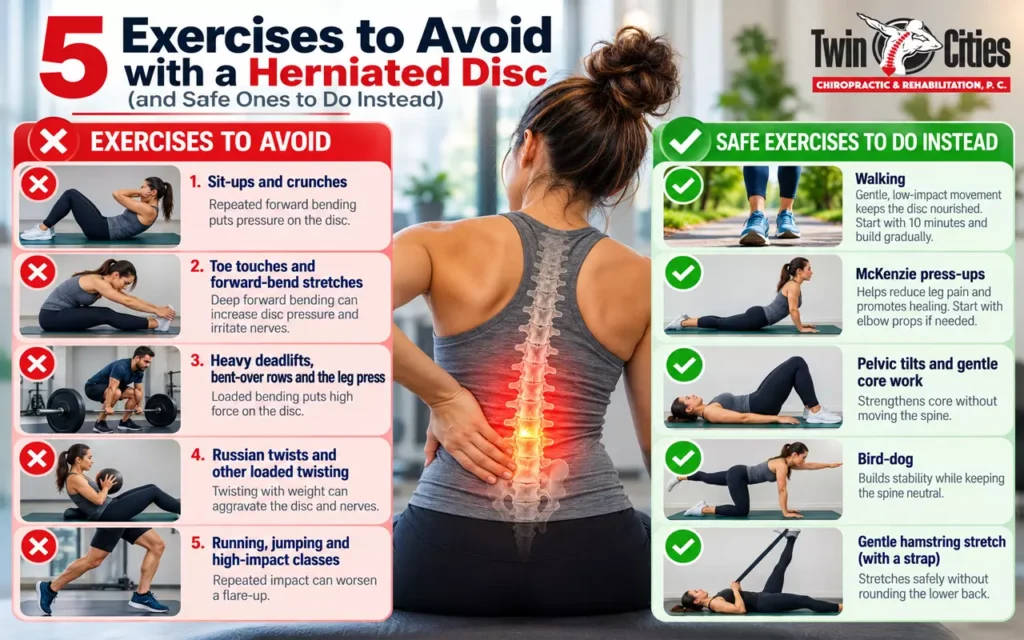
Most people with a herniated disc who come into our St. Paul office have already tried to exercise their way out of it. Some found a stretching routine online, some kept going to their usual classes at the gym, and a few started doing sit-ups because somebody told them a strong core would fix it. I understand the instinct. Moving is good for a disc, and lying in bed for a week usually makes things worse. The problem is that a handful of very common moves put pressure right where the disc is weakest, and doing them every day can keep a flare-up going for months.
So below are the five herniated disc exercises I ask patients to stop doing first, why they cause trouble, and what I’d have you do instead.
Can You Exercise with a Herniated Disc?
Yes, and in most cases you should. A disc doesn’t have much of a blood supply of its own, so it depends on movement to get fluid and nutrients in and out. People who keep walking and stay reasonably active tend to recover faster than people who rest completely.
What matters is the kind of exercise. Most low back herniations, including the very common L4-L5 and L5-S1 ones, push out toward the back of the disc, which is where the nerve roots sit. Bending forward, especially with weight in your hands or over and over, squeezes the front of the disc and pushes material toward the back. Twisting under load does something similar. So for the first several weeks, the general rule is to keep your spine fairly neutral and avoid repeated rounding.
I also give patients one simple test for any exercise. If the pain moves up out of your leg and toward your low back, that’s a good sign, even if your back aches a little more. We call that centralization. If the pain spreads farther down your leg, or you get new numbness or tingling, stop doing that exercise.
5 Exercises to Avoid with a Herniated Disc
1. Sit-ups and crunches
Sit-ups are usually the first thing people try when they want a stronger core, and they’re usually the first thing I ask disc patients to stop doing. Think about what a sit-up actually is. You curl your spine forward 20 or 30 times in a row, and a lot of people pull on their neck while they do it. Each of those reps squeezes the front of the disc and pushes the bulge back toward the nerve. I even put the chair crunches I recommend to healthy desk workers on hold until the disc calms down. You don’t have to give up core work. For now, though, it should be exercises where your back stays still, and your arms and legs do the moving.
2. Toe touches and forward-bend hamstring stretches
Tight hamstrings are common with a disc problem, so people bend over to reach for their toes or sit on the floor and fold forward. A lot of the time, what feels like a hamstring stretch is really the sciatic nerve being pulled tight past an irritated disc. That’s why it can feel good for a moment and then hurt worse that evening. Knee-to-chest stretches and some yoga poses, like a seated forward fold or plow, cause the same trouble for many disc patients. For now, leave the hamstrings alone, or stretch them lying on your back with a strap and your low back flat on the floor.
3. Heavy deadlifts, bent-over rows and the leg press
Plenty of the people I see for disc problems lift weights, and this is where they tend to get into trouble. For a healthy back, a deadlift with good form is fine. With an irritated disc, though, picking a loaded bar up off the floor puts a lot of force through that disc, and by the last few reps of a set most people’s form has started to slip. Bent-over rows are a problem for a different reason. You’re holding your spine bent forward with weight in your hands the whole time. Most people don’t expect the leg press to be on this list. But watch what happens at the bottom of the rep, when your knees come in close to your chest. Your hips lift off the pad and your low back rounds, with a few hundred pounds pushing on it. I’d take all three out of your routine until the pain is gone, then add them back with lighter weight.
4. Russian twists and other loaded twisting
Twisting with a weight in your hands, cable woodchops, and fast rotations in a fitness class all combine turning with bending, and discs handle that combination poorly. The same goes for hitting a large bucket of balls at the driving range or swinging hard in a softball league game while your disc is flared up. Twisting isn’t off-limits forever. In the early weeks, though, it’s one of the quickest ways to set yourself back.
5. Running, jumping and high-impact classes during a flare
Running isn’t bad for discs in general, and there’s some research suggesting regular runners actually have healthier discs. During an acute flare, though, jogging, jump rope, box jumps, or a HIIT class pound on an already inflamed disc thousands of times in one session. If you’re a runner, walk for now. Most of my patients who run around Lake Phalen or Como get back to it, just not in the first few weeks.
Safe Exercises for a Herniated Disc
This is what I usually start people on. Every back is a little different, so take it as a starting point and not a prescription.
Walking. It’s the most underrated exercise for a disc. Short walks several times a day keep the disc moving without loading it much. Start with 10 minutes on flat ground and build from there. When the sidewalks are icy in January, the downtown skyways work just as well.
McKenzie press-ups. The McKenzie method is widely used for disc herniations, and the prone press-up is its best-known exercise. Lie face down with your hands under your shoulders and slowly push your upper body up while your hips stay on the floor, then lower back down. If a full press-up is too much, start by propping up on your elbows. Use the centralization test. If your leg pain eases, this is probably a good exercise for you. If it spreads, stop, because not every disc responds to backward bending, and people with spinal stenosis often feel worse with it.
Bird dogs and dead bugs. Both train your core while your spine stays still. For a bird dog, get on your hands and knees and slowly reach one arm forward and the opposite leg back without letting your low back sag or twist. A dead bug works the same way, lying on your back.
Glute bridges. Lie on your back with your knees bent and lift your hips by squeezing your glutes, not by arching your back. Strong glutes take a lot of work off the low back.
Sciatic nerve glides. These are gentle back-and-forth movements, not stretches, that help the nerve slide more freely. Sit tall, then straighten one knee while you tip your head back, and bend the knee as you bring your chin down. Do ten easy reps without holding. If they stir up your leg symptoms, skip them for now.
If your leg pain feels more like a deep ache in the buttock than true nerve pain, it may not be a disc at all. We go through how to tell the difference between sciatica vs. piriformis syndrome.
L4-L5 Disc Herniation Exercises: Does the Level Matter?
A lot of patients come in with their MRI report and ask for exercises for their specific level, usually L4-L5 or L5-S1. It’s a fair question, but the level doesn’t change the plan as much as people expect. Most herniations in the low back happen at one of those two levels, and both follow the same basic rules. Avoid rounding your back over and over or under weight, avoid twisting while you’re holding something heavy, and stick with the movements that pull your pain up out of your leg. The bigger question for me is which way your particular disc likes to move and how angry the nerve is right now. I can only answer that by examining you, not by reading the report.
When to Stop and Get Checked
Exercise isn’t the answer for every disc. Go to an emergency room right away if you have numbness in the groin or inner thighs, trouble controlling your bladder or bowels, or leg weakness that’s getting worse. Those can be signs of serious nerve compression. Make an appointment if your pain isn’t improving after two or three weeks, if exercise keeps making the leg pain spread, or if you just aren’t sure which movements are safe for you.
How We Help at Twin Cities Chiropractic
At your first visit, I test how your back responds to different movements, so we know which direction your disc likes, and I check the nerve function in your legs. Treatment usually combines gentle adjustments where they’re safe, soft tissue work with our massage therapist Joy Vang, and a short home program built around what centralizes your pain. For patients who need more help, we also offer non-surgical spinal decompression. You can read more about how we handle disc problems on our herniated disc treatment page.
Get Help with Your Disc
If you’re not sure which exercises are helping and which are hurting, call Twin Cities Chiropractic at (651) 224-1921 or stop by 506 N. Lexington Pkwy, St. Paul, MN 55104.
Frequently Asked Questions
- What exercises should you avoid with a herniated disc?
The main ones are sit-ups and crunches, touching your toes or folding forward to stretch, and heavy deadlifts, rows, and leg presses. Twisting with a weight in your hands is another, and so is running or jumping while the disc is flared up. Some of these bend your spine forward while it’s carrying a load, and the others jar an already irritated disc over and over.
- Is walking good for a herniated disc?
Yes. For most people, it’s the best place to start. Short, frequent walks on flat ground keep the disc moving without much load.
- What are McKenzie exercises for a herniated disc?
They’re a set of movements, mostly backward bending like the prone press-up, used to find out whether your pain moves out of the leg and toward the back. They help a lot of disc patients but not all of them, so stop if your leg symptoms spread.
- How long should I avoid these exercises?
Usually until the leg pain is gone and you’ve done the safe exercises for a few weeks without trouble. Then add things back one at a time, starting light.
- Can I do yoga with a herniated disc?
Some of it. Gentle backbends like sphinx or cobra are often fine. Deep forward folds, seated twists, and plow are best left out until the disc settles down. Let your instructor know about your back.