
Neck Pain After a Minor Car Accident: Why You Shouldn’t Ignore “Small” Aches
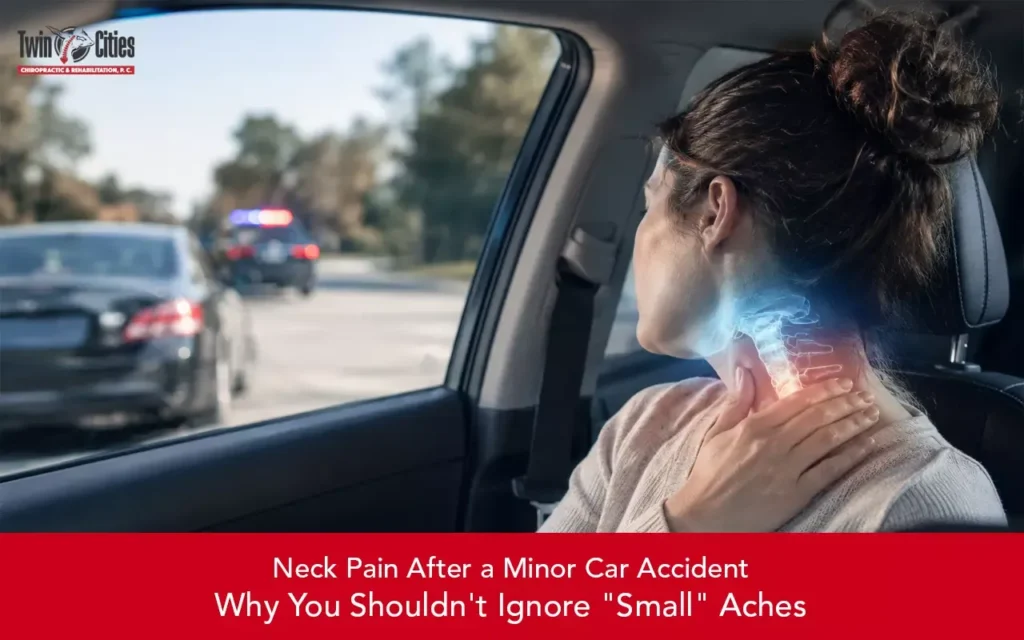
We’ve all been there. You’re sitting at a red light, maybe thinking about what to pick up for dinner at the St. Paul Whole Foods, when—thump. Someone taps your bumper from behind.
You get out, check the cars, and there’s barely a scratch. You exchange insurance info, tell the other driver, “I’m fine, don’t worry about it,” and go about your day. You might feel a little “buzzed” from the adrenaline, but you figure you dodged a bullet.
But then, 48 hours later, it hits you. Your neck feels like it’s in a vice. You have a dull headache that won’t go away, and your shoulders feel like they’re up around your ears.
If you are experiencing neck pain after a minor car accident, I want you to listen closely: Do not ignore it.
As a chiropractor who has spent 25 years treating auto accident victims in the Twin Cities, I can tell you that the “minor” fender bender is often the most dangerous kind of crash. Why? Because when there is no damage to the car, people assume there is no damage to their body.
Let’s talk about the physics of low-speed crashes, why your symptoms are hiding, and why getting checked out now can save you from years of chronic pain later.
The “No Damage” Delusion
The biggest mistake people make is looking at their car to determine if they are injured. It seems logical: “If the bumper isn’t dented, how could my neck be hurt?”
Actually, the opposite is often true.
Modern cars are designed with “crumple zones.” When a car crumples, it is absorbing the energy of the impact. If the car doesn’t crumple (which often happens in low-speed hits under 10 mph), that energy doesn’t just vanish. It is transferred directly through the frame of the car and into the seat—and then into you.
Your head weighs about 10 to 12 pounds. In a rear-end collision, even at 5 mph, your head is whipped backward and then forward in a fraction of a second. This “whip” creates a massive amount of force on the tiny ligaments and tendons in your upper neck.
In the world of physics, this is called “impulse.” You can have zero damage to your car’s plastic bumper and still have significant tearing in the soft tissues of your cervical spine.
Why You Feel “Fine” Right After the Crash
If you were injured, you’d know it immediately, right? Not necessarily.
When you get into an accident, your body goes into “Survival Mode.” Your brain floods your system with adrenaline and endorphins. These are nature’s painkillers. They are designed to help you stay calm, exchange insurance info, and get home safely.
This adrenaline mask can last for hours, or even days. It’s only once your nervous system finally “powers down” and the initial inflammation starts to set in that you feel the true extent of the damage. This is why we see so many delayed whiplash symptoms that don’t peak until 3 to 5 days after the actual event.
4 “Small” Symptoms That Signal a Big Problem
If you’ve been in a minor crash recently, keep a close eye out for these four “red flag” symptoms. They might feel like minor annoyances now, but they are signs that your spine has been compromised.
1. The “Heavy Head” Feeling
Do you feel like you need to prop your head up with your hand while sitting at your desk? This is a sign that the deep stabilizer muscles in your neck have been strained and are “fatigued.” They can no longer hold the weight of your head properly.
2. The “End of Day” Headache
If you feel fine in the morning but have a pounding headache by 4:00 PM, it’s likely a cervicogenic headache. This happens when the top two vertebrae in your neck are misaligned from the “whip” of the accident, putting pressure on the nerves that travel into your skull.
3. Numbness or “Fuzziness” in Your Fingers
Even if your neck doesn’t hurt that much, if you feel a strange tingling or “pins and needles” in your hands, you have a nerve issue. The nerves that control your arms exit from your neck. If a disc was budged during the crash, it could be “pinching” the nerve.
4. Difficulty Concentrating (“Brain Fog”)
Do you feel “spaced out” or like you’re moving through a cloud? This is often a sign of a minor concussion or a disruption in the blood flow to the brain caused by upper neck misalignment.
The Minnesota No-Fault Advantage
I hear this all the time: “I don’t want to go to the doctor because I don’t want my insurance rates to go up, and it’s just a little ache.”
Here is the reality of living in Minnesota: We are a No-Fault state.
This means that your own auto insurance is legally required to have a “Personal Injury Protection” (PIP) bucket of money (usually $20,000 or more) specifically for medical care after an accident. This money is there whether the accident was your fault or not.
Using this benefit does not “penalize” you; it’s what you’ve been paying for every month in your premiums. It covers your chiropractic adjustments, your massage therapy with Joy Vang, and any necessary exams. You can get the care you need to heal correctly without worrying about the bill.
Why “Wait and See” is a Dangerous Game
If you have a minor tear in a ligament in your neck and you don’t treat it, your body will heal it with scar tissue.
Scar tissue is like the “duct tape” of the body. It’s strong, but it’s not flexible. If you let scar tissue set in while your neck is misaligned, you are essentially locking your spine in a crooked position.
Fast forward five years: that “minor” neck ache has turned into premature arthritis, chronic migraines, and a loss of range of motion that makes it hard to drive safely. I see this every week in my office—patients in their 40s with “old man” necks because of an untreated “minor” accident in their 20s.
How We Help You Recover
At Twin Cities Chiropractic, we specialize in the “soft tissue” side of car accidents that the ER often misses.
1. The Expert Exam: Dr. Sorum has 25 years of experience identifying the subtle misalignments that cause delayed pain. We’ll check your range of motion, your reflexes, and your nerve function to see exactly what happened during that “minor” hit.
2. Gentle Realignment: We don’t use “aggressive” movements on a fresh injury. Dr. Sorum uses gentle, precise chiropractic adjustments to get the joints moving again, which allows the inflammation to finally drain away.
3. Soft Tissue Repair: This is where Joy Vang comes in. She uses specialized massage techniques to break up the “pooling” inflammation and ensure that the scar tissue your body is building stays flexible and healthy.
Don’t Let “Minor” Become “Permanent”
If you’ve been in an accident—even if there isn’t a scratch on your car—do yourself a favor and get checked out. It’s much easier to fix a 3-day-old injury than a 3-year-old one.
You have nothing to lose by getting an evaluation, but you have your long-term health to lose by ignoring the warning signs.
Still feeling “off” after a fender bender? Call Twin Cities Chiropractic at 651-224-1921. We are located at 506 N. Lexington Parkway in St. Paul. Dr. Sorum has been helping St. Paul accident victims get back to 100% for over 25 years. Call today to schedule your post-accident evaluation.
Frequently Asked Questions
1. How long do I have to see a doctor after an accident in Minnesota?
Under Minnesota No-Fault law, you should seek medical attention as soon as possible. While there isn’t a “strict” 72-hour rule like in some other states, waiting more than a week or two can make it much harder to prove that your injuries were caused by the accident, which can complicate your insurance claim.
2. What if the other driver didn’t have insurance?
Because Minnesota is a No-Fault state, your own insurance (PIP) covers your medical bills regardless of the other driver’s status. You are protected even if the other person was uninsured or if it was a hit-and-run.
3. Can whiplash cause dizziness or vertigo?
Absolutely. This is called “Cervicogenic Dizziness.” When the upper vertebrae in your neck are misaligned, they send “scrambled” signals to your brain about where your head is in space. This conflict between your eyes, your ears, and your neck causes that lightheaded, dizzy feeling.
4. Will chiropractic adjustments hurt after an accident?
No. When you have a fresh injury, we use very gentle, low-force techniques. Our goal is to reduce inflammation and “calm down” the nervous system, not to cause more stress. Most patients feel a sense of “release” and relief after their first post-accident adjustment.
5. Do I need a lawyer before I see a chiropractor?
No. Your priority should always be your health. You can seek medical care immediately. If you decide you need legal help later to deal with car damage or lost wages, we can provide your attorney with the detailed medical documentation they need to support your case.